
 Consumers today know more and move faster than ever before. They have access to all the information they need to make informed decisions at any time. That means more data, and more information needs to be constantly processed by companies and their customers. This trend is not going to stop anytime soon. Quite the opposite.
Those businesses that know how to process and structure this data explosion best and most efficiently will be able to attract and retain a large number of customers.
Smart Technologies and Smart Products Need Smart Users!
In the past, experts and companies knew more about their respective services and products than their end users.
Today, recent innovations in mobile and sensor technology make it possible to create a digital representation of almost any physical component and its parameters at any time and any place. Physical worlds and digital representations are becoming tightly linked, so that changes in one world have an impact on the other. (e.g. Radio Frequency Identification (RFID))
Your business location is changing before your eyes:
"Technology is enabling service providers to make the location of their customers the location of their business." [i]
Smart products are smart because they filter and interpret information to enable users to act more effectively. Smart products developed by knowledge-based companies can be identified by a few characteristics: They are interactive, they get smarter the more you use them, and they can be customized.
As a result, consumers are increasingly becoming learners, using smart products that engage them and help them learn. Companies need to move to making their offerings smarter because everyone benefits. After all, when customers use these products, they engage in a learning process.
The New Way of Thinking
Seeing customers as learners requires a major shift in thinking. Companies will shift to seeing their customers as learners and themselves as teachers. They will profitably promote the learning experience, and their customers will benefit from that experience.
In the coming years, how people use knowledge-based products, both as consumers and at work, will be critical to business success. The value of a business will be determined similarly: Businesses that are based on providing information to customers will do better than those that do not, and businesses that understand how to turn information into knowledge will be the most successful.
The Reorientation of the Economy From Data to Information to Knowledge.
Technological change is driving the next wave of economic growth. To benefit from this growth, we must not only adopt new technologies, but also new ways of thinking. Of critical importance will be our ability to understand the shift in business from data to information to knowledge.
This can be seen, for example, in Amazon's evaluation of bestselling products. Amazon collects, analyzes, and uses data from its customers and the best features of the product to then develop its own product. Then they undercut this bestseller by offering their product for 20-45% cheaper.
There is a growing awareness that information is no longer just a by-product of the core business and that the value created by the content exceeds the value of the original business itself.
Change Is Happening Again.
Data is the basic building block of the information economy and a knowledge-based enterprise. In the beginning years, we focused on data, such as numbers, words, sounds, and images. What we did with that data - how we processed, stored, or otherwise manipulated it - determined its value.
Information is data arranged in meaningful patterns. for example, numbers are data, consequently a table of numerical values is information. In the 1950s, room-sized computers made it possible to collect, sort, store, and process vast amounts of data. Today, it's faster, less expensive, and compressed to the size of millimeters.
As a business, we are on the cusp of the transition from information to knowledge, where knowledge means the application and productive use of information.
Data is a commodity by now, but far less powerful or valuable than the information derived from it. Knowledge will replace information, just as information once replaced data.
Businesses As Educators
The evolution of knowledge-based enterprises reflects an even larger shift in our society. The learning market is being dramatically redefined to include not only regular students but also lifelong learners. A whole new meaning of education and learning is emerging.
The jobs of tomorrow that students are preparing for today have not yet been invented. Things taught in our schools and colleges today will already be obsolete by the time students graduate.
You have to increase your learning power to sustain your earning power.
The rapid pace of technological change means that learning must be constant and that education must be updated throughout working life. People must increase their ability to learn to maintain their earning power.
Alvin Toffler, futurist and author of the famous book Future Shock (1970), stated that "the illiterates of the 21st century will not be those who cannot read and write, but those who cannot learn, unlearn and relearn."
For companies to remain competitive and workers to remain employable, they must continually educate themselves.
Buckminster Fuller, American architect, author, inventor, and futurist, described 1981 the "knowledge doubling curve" in his book "Critical Path". [ii] He noted that human knowledge doubled about every hundred years until 1900 and doubled every 25 years until the end of World War II. A few years later, a report published by IBM predicted that knowledge would double every 12 hours by 2020, driven by the Internet of Things [iii][iiii].
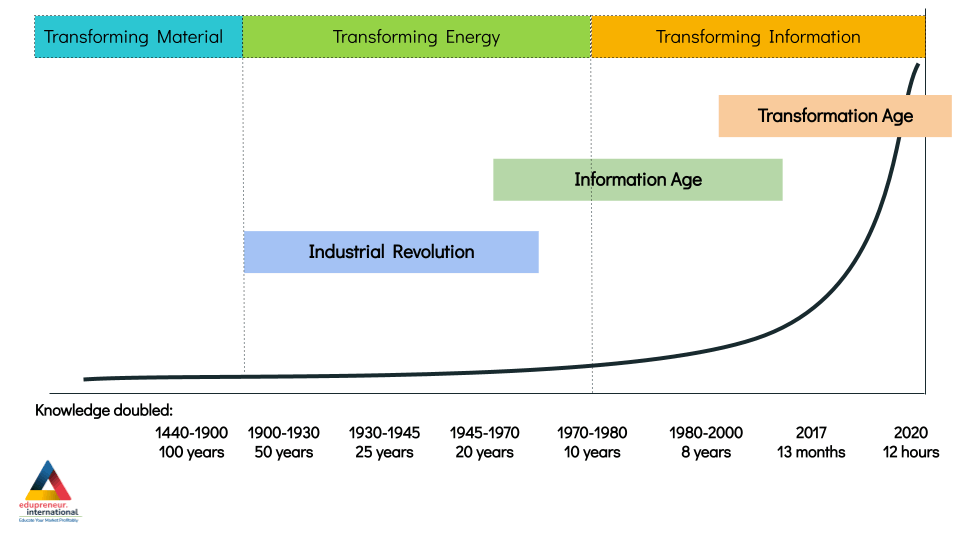
While different types of knowledge have different growth rates, it is widely recognized that human knowledge is increasing at an exceptional speed. We may have reached a point where relevant knowledge is growing faster and in greater quantity than we can absorb.
Knowledge Is Increasing, But The Usable Life Span of Knowledge Is Decreasing.
Consequently, in a continuous process of unlearning and learning, we must constantly replace outdated knowledge with new knowledge. However, knowledge alone is not enough. Equally important is the ability to make an informed judgment based on knowledge - what we call wisdom. It is knowledge and wisdom put into action that gives us insight.
Consumers Are the Newest and Largest Learning Segment in the Twenty-First-Century Marketplace.
As information technologies become friendlier, smarter, and integrated into more and more products and services, learning becomes a necessary by-product (and by-service). Never before have customers seen themselves as learners and companies as teachers.
More than government structures can, businesses are pioneering the educational changes needed for the emerging knowledge economy. Public and private school systems are lagging behind the changes in learning that are already taking place outside the rigid established school and education system.
?????????In the coming decades, the private sector will replace the public sector as the dominant educational institution: faster, cheaper, driven by consumer data, and thus more targeted and helpful.
Discover how to transform your business into a knowledge-based enterprise, which is an industry that will grow by 21% over the next four years. -> CLICK to Learn More Here <-
[i]Fano, A.E.; Gershman, A. (2002). "The future of business services in the age of ubiquitous computing."
[ii] Fuller,R. B.1981.Critical Path.New York: St. Martin?s Press.
[iii] Feras A. Batarseh, ?Thoughts on the future of human knowledge and machine intelligence.? LSE Business Review, Sept. 20, 2017.
[iiii] Schilling,D. R. 2013. ?Knowledge Doubling Every 12 Months, Soon to be Every 12?Hours.?
?????
Photo by Michael Dziedzic on Unsplash